
Extracorporeal Shockwave Therapy (ESWT) in Louisville, KY
Clinical Approach Designed by Dr. Brandon Evans, PT, DPT | Kentucky Is a Direct-Access State | No Physician Referral Required
Chronic Tendon Pain That Has not Responded to Rest, Stretching, or Basic Strengthening
For adults 45 and older, stubborn tendon pain rarely stays contained to one activity. It shows up on stairs, on a walk, mid-round of golf, or in the middle of the night. Extracorporeal Shockwave Therapy (ESWT), commonly called radial shockwave therapy, is a non-invasive treatment that uses acoustic pressure waves to stimulate a targeted tissue response in chronic tendon and soft-tissue conditions.
ESWT is a tool, not a whole treatment plan. The plan starts with a thorough evaluation to confirm the diagnosis and determine whether ESWT is actually the right fit for your tissue and your history. If it is not, we will tell you that directly and point you toward what is.
Complimentary conversation first — no pressure, no obligation.
Prefer to text or email instead? Same number: (502) 512-2165.
What ESWT Is — and What It Isn't
This is:
- A non-invasive acoustic pressure wave treatment for chronic tendon and soft-tissue pain
- Evaluation-led, so the diagnosis is confirmed before treatment begins
- Available as its own focused plan, or integrated into a physical therapy episode of care
- Delivered on our Chattanooga Intelect radial pressure wave (RPW) system
- One part of a plan — most lasting results still depend on progressive loading afterward
This is not:
- Surgery, or a substitute for a surgical consult when one is genuinely needed
- A guaranteed fix, or a substitute for an accurate diagnosis
- The right first step for acute injuries, fractures, or active infection
- A decision we make for you about medication or other medical treatment
- Something we sell before we evaluate you
What Is Radial Shockwave Therapy?
Radial shockwave therapy, one of the two main forms of ESWT, uses a pneumatic (ballistic) handpiece to generate a pressure wave at the skin's surface that spreads outward and downward into tissue. It is distinct from focused shockwave therapy, which uses an electromagnetic handpiece to concentrate higher peak energy at a specific depth. Radial devices place their maximum energy at the surface and dissipate it with depth, which makes them well suited to broader, more superficial tendon and soft-tissue areas; focused devices are typically chosen when energy needs to be concentrated deeper or more precisely.
We use a Chattanooga Intelect radial pressure wave (RPW) system, which delivers adjustable pressure (roughly 0.3 to 5.0 bar) and pulse frequency through interchangeable transmitter heads, reaching therapeutic depths of up to about 6 centimeters depending on the attachment and setting used. Which pressure, frequency, and transmitter we use depends entirely on your diagnosis and tissue depth, which is why the evaluation comes first.
How ESWT Is Thought to Work
The leading explanation for how shockwave therapy helps chronic, "stuck" tendon pain is mechanotransduction: the pressure wave creates a mechanical stimulus that cells convert into biochemical activity. In tendons where normal healing has stalled, this stimulus is thought to help trigger new blood vessel formation, encourage collagen turnover, and modulate local pain signaling, essentially prompting tissue that has stopped healing on its own to restart that process.
This is a proposed biological mechanism supported by laboratory and clinical research, not a guarantee of a specific outcome for any individual. How well it works still depends on an accurate diagnosis, appropriate dosing, and what happens after the session, particularly progressive loading and strengthening.
Two Paths After Your Evaluation
Not everyone who benefits from ESWT needs a full course of formal physical therapy. Your evaluation determines which path fits your situation, delivered by our licensed physical therapy team, with a clinical approach designed by Dr. Brandon Evans, PT, DPT.
Option 1: ESWT-only care
- For tissue where formal physical therapy is not the missing piece
- A focused, time-bound plan for the diagnosed tendon or soft tissue
- Clear guidance on activity and loading between sessions
Option 2: ESWT integrated with physical therapy
- For when the true cause of pain also needs strength, mobility, or movement correction
- A progressive loading plan so results are more likely to last
- Built as one episode of care, not a separate add-on
Conditions ESWT May Help
ESWT is most commonly used for chronic tendon and soft-tissue conditions, especially when symptoms have lingered for months or keep returning despite rest and basic exercise. Not all pain is a good fit for ESWT. Your evaluation confirms the diagnosis first.
Foot and ankle
Conditions: Plantar fasciitis and chronic heel pain, Achilles tendinopathy, posterior tibial tendon pain, peroneal tendon pain, chronic calf strains.
Evidence: Plantar fasciitis and Achilles tendinopathy have the strongest research base for shockwave therapy of any condition it is used for, including recognition from the UK's National Institute for Health and Care Excellence (NICE) for refractory cases of both.
Knee, hip, and thigh
Conditions: Patellar tendinopathy (jumper's knee), quadriceps tendon pain, gluteal tendinopathy, greater trochanteric pain syndrome, proximal hamstring tendon pain.
Evidence: Research here is generally favorable, particularly for gluteal tendinopathy and greater trochanteric pain syndrome, though study quality varies more than it does for foot and ankle conditions.
Shoulder, elbow, and arm
Conditions: Calcific shoulder tendinopathy, rotator cuff tendinopathy (case-dependent), biceps tendinopathy (case-dependent), tennis elbow (lateral epicondylitis), golfer's elbow (medial epicondylitis).
Evidence: Calcific shoulder tendinopathy has solid supporting research. For tennis elbow and golfer's elbow, the research is genuinely mixed. Some trials show meaningful benefit, especially when shockwave is paired with an exercise program, while others show no clear advantage over a sham treatment. We will be direct with you about that uncertainty during your evaluation rather than overpromising.
Muscle and myofascial trigger points
Conditions: Tight, painful bands within muscle, sometimes called trigger points, that can refer pain elsewhere and contribute to chronic tendon symptoms.
Evidence: Radial pressure wave devices, including our Chattanooga RPW system, are also used to help release myofascial trigger points. If trigger points, rather than a tendon itself, turn out to be the main driver of your pain, dry needling may be a more targeted option. Your evaluation determines which approach actually fits what is driving your pain.
What to Expect During a Session
During the session
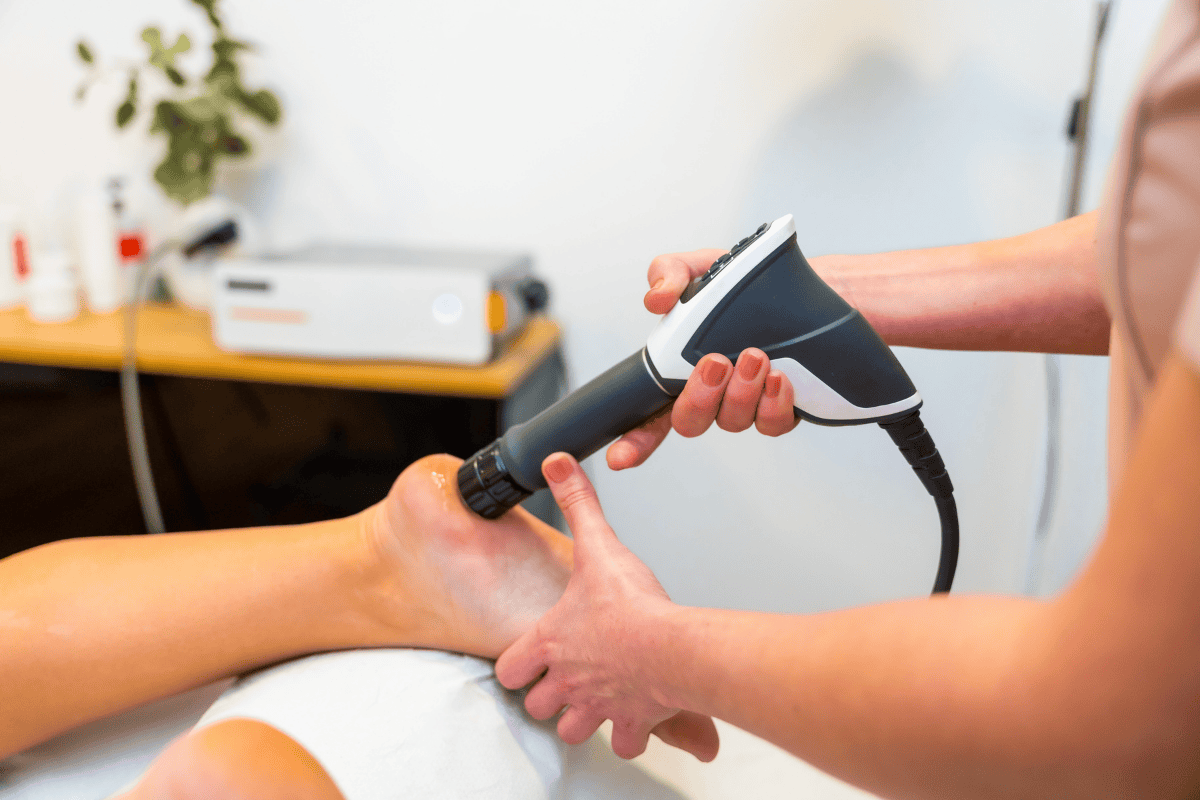
A targeted assessment of the painful area, gel applied to improve wave transmission, then several minutes of controlled acoustic pulses delivered through the Chattanooga RPW system at the pressure, frequency, and depth setting matched to your diagnosis. Most people describe it as uncomfortable but tolerable, and we adjust intensity based on your comfort and how the tissue responds.
After the session
Temporary soreness, similar to a workout, for 24 to 48 hours can be normal. We will give you clear guidance on activity and any exercises for that window. Most plans involve roughly 1 to 6 sessions spaced about a week apart, but the right number depends entirely on your diagnosis and how long symptoms have been present.
Why Your Evaluation Matters More Than the Machine
Plenty of places have a shockwave machine. Fewer lead with the evaluation, diagnosis, and plan that determine whether it actually helps. ESWT can support pain reduction and a local tissue response, but it does not, by itself, restore strength, fix movement mechanics, or prevent the pain from returning.
Skilled physical therapy is the clinical decision-making around the tool: identifying why the pain is happening, choosing the right interventions, and progressing your loading safely afterward. The tool matters. The decision-making behind it matters more.
"After three sessions, I am walking better, I can feel my feet better, and I am finally able to do exercises I have not been able to do without pain in over 10 years."
Patient in her 70s. Individual results vary. Your plan depends on your evaluation and diagnosis.
Why ProActive
- Evaluation and diagnosis always come before treatment, never the other way around
- Kentucky is a direct-access state, so you can start your evaluation without waiting on a referral
- Delivered by our licensed physical therapy team, with a clinical approach designed by Dr. Brandon Evans, PT, DPT, grounded in an accurate diagnosis, not a one-size-fits-all protocol
- ESWT-only or integrated with physical therapy, based on what your evaluation actually shows
Visit Our Louisville Clinic
Serving Lyndon, St. Matthews, Hurstbourne, and the greater Louisville, KY area.
Frequently Asked Questions
What is radial shockwave therapy?
Radial shockwave therapy is one of the two main forms of Extracorporeal Shockwave Therapy (ESWT). It uses a pneumatic handpiece to deliver a pressure wave that concentrates energy at the skin's surface and spreads it into tissue, making it well suited to broader, more superficial tendon conditions. We deliver it using a Chattanooga Intelect radial pressure wave (RPW) system.
Does ESWT hurt?
Most people describe it as uncomfortable but tolerable. We adjust pressure and frequency based on your comfort and how the tissue responds, and some temporary soreness for 24 to 48 hours afterward is normal.
What conditions can ESWT help with?
ESWT is most commonly used for chronic tendon and soft-tissue conditions such as plantar fasciitis, Achilles tendinopathy, patellar tendinopathy, gluteal tendinopathy, greater trochanteric pain syndrome, calcific shoulder tendinopathy, tennis elbow, and golfer's elbow. Evidence is stronger for some of these than others. Your evaluation confirms whether it is appropriate for your specific diagnosis.
Can I get ESWT without starting formal physical therapy?
Yes. If your evaluation shows that formal physical therapy is not the missing piece, we offer ESWT-only care. If the true cause of your pain also needs strength or movement work, ESWT can be integrated into a physical therapy plan instead.
Do I need a physician's referral to start?
No. Kentucky is a direct-access state, which means you can start an ESWT evaluation at ProActive Physical Therapy and Wellness without a physician's referral. Medicare and some insurance plans have their own separate requirements, so call or text us and we will walk you through what applies to your specific situation.
How many sessions will I need?
Most plans involve roughly 1 to 6 sessions, spaced about a week apart, but the right number depends on your diagnosis, how long symptoms have been present, and how your tissue responds. We outline a clear plan after your evaluation.
What happens during a session with the Chattanooga RPW device?
We assess the painful area, apply gel to improve wave transmission, then deliver several minutes of controlled acoustic pulses at a pressure, frequency, and depth setting matched to your diagnosis, followed by guidance on activity and loading.
Is ESWT covered by insurance or Medicare?
Coverage varies by diagnosis, insurer, and whether ESWT is delivered on its own or integrated with physical therapy. We will review your specific options clearly before you start.
How do I get started?
Request an appointment online, or call or text us at (502) 512-2165. We will talk through your history and schedule an evaluation to determine whether ESWT-only care or ESWT integrated with physical therapy is the right next step.
Complimentary conversation first — no pressure, no obligation.
Prefer to text or email instead? Same number: (502) 512-2165.
This page is for educational purposes and does not replace an individualized evaluation. A clinician must determine whether ESWT is appropriate for your condition and health history.
Sources
d'Agostino MC, Craig K, Tibalt E, Respizzi S. Shock wave as biological therapeutic tool: from mechanical stimulation to recovery and healing, through mechanotransduction. Int J Surg. 2015;24(Pt B):147-153.
National Institute for Health and Care Excellence (NICE). Extracorporeal shockwave therapy for refractory plantar fasciitis. Guidance HTG200 (formerly IPG311).
National Institute for Health and Care Excellence (NICE). Extracorporeal shockwave therapy for refractory Achilles tendinopathy. Guidance IPG312 / HTG426.
Gerdesmeyer L, et al. Current evidence of extracorporeal shock wave therapy in chronic Achilles tendinopathy. Int J Surg. 2015;24(Pt B):154-159.
Schmitz C, et al. Efficacy and safety of extracorporeal shock wave therapy for orthopedic conditions: a systematic review on studies listed in the PEDro database. Br Med Bull. 2015;116:115-138.
Guede-Rojas F, Rodriguez-Lagos L, Carvajal-Parodi C, et al. Effectiveness of radial extracorporeal shockwave therapy versus other electrophysical modalities on pain and functionality in patients with plantar fasciitis: a systematic review and meta-analysis. 2026.
