
PEMF Therapy in Louisville, KY
Clinical Approach Designed by Dr. Brandon Evans, PT, DPT | Not Physical Therapy | Not Billed to Insurance or Medicare
A Research-Informed Recovery Modality for Pain, Inflammation, and Healing
Pulsed electromagnetic field (PEMF) therapy uses low-level electromagnetic pulses to stimulate circulation and cellular activity in painful or slow-healing tissue. It's non-invasive, requires no needles or medication, and most people find it completely painless. At ProActive Physical Therapy and Wellness, PEMF is offered as a recovery modality that can stand on its own or work alongside a physical therapy plan, guided by a clinical approach designed by Dr. Brandon Evans, PT, DPT.
This isn't a substitute for physical therapy or for whatever your physician has already prescribed. It's a complementary tool, and we'll always talk through your specific history before recommending it.
Talk to us first — complimentary, no pressure, no obligation.
Prefer to text or email instead? Same number: (502) 512-2165.
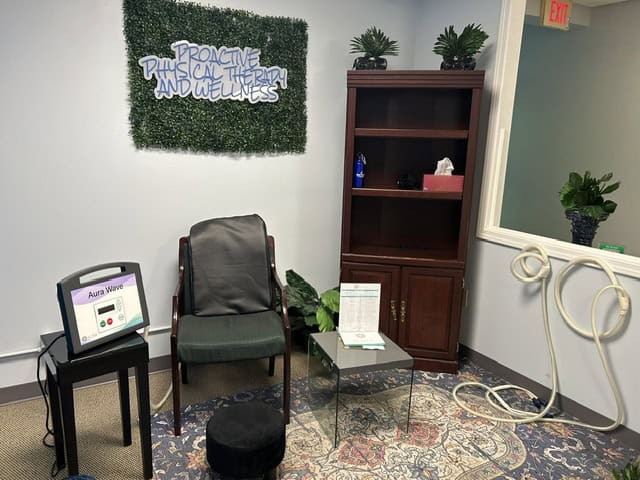
What Is PEMF (Pulsed Electromagnetic Field) Therapy?
PEMF therapy is a non-invasive treatment that delivers low-level, pulsed electromagnetic waves into the body, most often through a mat, pad, or targeted applicator placed over the area being treated. The pulses create a brief, low-intensity electromagnetic field that research suggests can influence cell membrane activity, circulation, and inflammatory signaling in the treated tissue.
PEMF is different from a TENS unit or electrical stimulation, which pass an electrical current directly through the skin. PEMF doesn't require skin contact with electrodes and isn't felt as a shock or muscle contraction — most patients feel warmth, a mild tingle, or nothing at all.
What This Is — and What It Isn't
This is:
- A non-invasive recovery and wellness modality
- Offered under a clinical approach designed by Dr. Brandon Evans, PT, DPT
- Research-informed, with evidence that varies by condition
- A complement to physical therapy or medical treatment already in place
- Painless, with no needles and no downtime
This is not:
- Physical therapy
- Billed to insurance or Medicare
- A cure or a guaranteed fix
- A replacement for medical treatment your doctor has prescribed
- Appropriate for everyone — some health conditions rule it out
How PEMF Therapy Works
Every cell in the body carries a small electrical charge and communicates in part through electrical signaling. Injury, inflammation, and chronic pain can disrupt that signaling at the cellular level. PEMF applies a pulsed electromagnetic field to the treated area, which research indicates can affect ion movement across the cell membrane, support local circulation, and modulate inflammatory activity in the tissue.
Sessions typically run 20 to 30 minutes, depending on the area and device settings. You stay fully clothed, sit or lie near the applicator, and there's no recovery time needed afterward.
Source: Funk RH. Coupling of pulsed electromagnetic fields (PEMF) therapy to molecular grounds of the cell. Am J Transl Res. 2018;10(5):1260-1272. Flatscher J, Pavez Loriè E, Mittermayr R, et al. Pulsed Electromagnetic Fields (PEMF): Physiological Response and Its Potential in Trauma Treatment. Int J Mol Sci. 2023;24(14):11239.
What Does the Research Actually Say?
PEMF has been studied for decades, and the evidence is genuinely stronger for some uses than others. We'd rather tell you where the research is solid and where it's still mixed than oversell any of it.
Low back pain
A 2025 systematic review of nine randomized controlled trials (420 patients) found that five of the nine studies showed statistically significant improvement in pain and physical function compared with control groups, with no serious adverse events reported across any of the included trials. The review concluded that PEMF appears to be a safe, beneficial option for non-specific low back pain, particularly as an addition to standard physical therapy.
Source: Crevenna R, et al. Efficacy of pulsed electromagnetic field therapy on pain and physical function in patients with non-specific low back pain: a systematic review. Wien Med Wochenschr. 2025;175(1):11-19.
Knee osteoarthritis
Results here are mixed, and we think that's worth saying plainly. An earlier systematic review and meta-analysis found PEMF associated with meaningful improvement in pain and stiffness for knee osteoarthritis. A more recent 2026 meta-analysis of nine RCTs found no significant improvement in overall pain scores at one month, but did find significant improvement in stiffness and daily activity scores, with benefits that appeared to depend on the specific device settings and timing used. Bottom line: PEMF may help some people with knee osteoarthritis feel and move better, but it isn't a guaranteed or uniform effect.
Sources: Chen L, Duan X, Xing F, et al. Effects of pulsed electromagnetic field therapy on pain, stiffness and physical function in patients with knee osteoarthritis: a systematic review and meta-analysis of randomized controlled trials. J Rehabil Med. 2019;51(11):821-827. Huang WC, et al. Pulsed Electromagnetic Field Therapy in People with Knee Osteoarthritis: A Systematic Review and Meta-Analysis. Medicina. 2026;62(4):677.
Bone healing
This is the longest-studied use of PEMF. The FDA has cleared PEMF bone growth stimulator devices for nonunion fractures since 1979. A 2020 systematic review and meta-analysis pooling 14 randomized controlled trials (1,131 patients) found a bone healing rate of 79.7 percent in the PEMF group compared with 64.3 percent in the control group. The review also noted that PEMF's role is still not universally standardized as first-line treatment, so it's used as a supportive tool alongside, not instead of, the care your orthopedic provider directs.
Sources: Peng L, Fu C, Xiong F, et al. Effectiveness of pulsed electromagnetic fields on bone healing: a systematic review and meta-analysis of randomized controlled trials. Bioelectromagnetics. 2020;41(5):323-337. Cadossi R, Massari L, Racine-Avila J, Aaron RK. Pulsed Electromagnetic Field Stimulation of Bone Healing and Joint Preservation: Cellular Mechanisms of Skeletal Response. JAAOS Glob Res Rev. 2020;4(5):e19.00155.
Peripheral neuropathy pain
A double-blind, sham-controlled randomized controlled trial of 182 people with painful diabetic peripheral neuropathy found that twice-daily PEMF treatment over 18 weeks improved pain scores and skin perfusion compared with sham treatment. This is a specific, well-designed trial in a specific population — it doesn't automatically generalize to every type of nerve pain, but it's a genuinely solid data point for diabetic neuropathy specifically.
Source: Tassone EE, Page JC, Slepian MJ. Assessing the Effects of Pulsed Electromagnetic Therapy on Painful Diabetic Distal Symmetric Peripheral Neuropathy: A Double-Blind Randomized Controlled Trial. J Diabetes Sci Technol. 2025;19(2):361-369.
Who PEMF Therapy May Help
- Adults with joint or soft tissue pain, such as low back, knee, or shoulder discomfort
- People recovering from a soft tissue injury, sprain, or strain
- Adults managing osteopenia, osteoporosis, or a slow-healing or nonunion fracture, alongside their physician's care
- People with diabetic peripheral neuropathy pain
- Patients finishing a physical therapy episode who want an added recovery tool
PEMF often pairs naturally with the issues we treat in back pain, knee pain, and shoulder pain physical therapy, and with bone health goals addressed in the ProActive Osteogenic Strength Program. We'll help you figure out whether it makes sense on its own or alongside one of those.
What to Expect at a Session
You'll stay fully clothed and either sit or lie near the applicator for about 20 to 30 minutes. There's no needle, no shock, and no recovery time — most people go straight back to their day afterward. Before your first session, we'll talk through your health history to confirm PEMF is a good fit, and how many sessions makes sense depends on what you're treating and how you respond.
Who Should Check With Us First
PEMF is considered safe for most people, but it isn't right for everyone. It's generally not recommended during pregnancy, or for anyone with a pacemaker, insulin pump, or other implanted electronic device, a medication delivered through a skin patch, or epilepsy. If you're dealing with significant pain, dizziness, gait instability, or another active medical concern, physical therapy may need to come first. Talk to us and we'll help you figure out the right starting point.
Why This Matters
Pain and slow healing can quietly shrink what you're willing to do. PEMF isn't a cure, and we won't pretend it is, but for the right person and the right condition, it's a low-risk, well-tolerated tool that can support recovery alongside the physical therapy or medical care you're already receiving. We'll always be straight with you about what the research does and doesn't support for your specific situation.
Why ProActive
- Every recommendation is based on your specific history, never a one-size-fits-all package
- Delivered by our licensed physical therapy team, with a clinical approach designed by Dr. Brandon Evans, PT, DPT
- We'll tell you honestly when the research is strong, when it's mixed, and when PEMF isn't the right tool for your situation
Visit Our Louisville Clinic
Serving Lyndon, St. Matthews, Hurstbourne, and the greater Louisville, KY area.
Frequently Asked Questions
What is PEMF (pulsed electromagnetic field) therapy?
PEMF therapy is a non-invasive treatment that delivers low-level, pulsed electromagnetic waves into the body to support circulation, cellular activity, and inflammatory response in the treated tissue. It's painless and requires no needles or medication.
How does PEMF therapy work?
PEMF applies a pulsed electromagnetic field to the treated area, which research indicates can affect ion movement across cell membranes, support local circulation, and modulate inflammatory activity. Sessions typically run 20 to 30 minutes, and you stay fully clothed throughout.
Does research actually support PEMF therapy?
It depends on the condition. Evidence is strongest for bone healing, where PEMF has FDA clearance for nonunion fractures dating to 1979, and reasonably solid for low back pain and diabetic peripheral neuropathy pain. Evidence for knee osteoarthritis is more mixed, with some studies showing meaningful improvement and others showing limited or inconsistent effects. We'll walk you through what the research shows for your specific situation rather than making a blanket promise.
Is PEMF therapy the same as physical therapy?
No. PEMF is a wellness and recovery modality, not physical therapy, and it isn't billed to insurance or Medicare. It's often used alongside physical therapy or medical treatment, not in place of it. If you have significant pain, dizziness, or a balance disorder, physical therapy may need to come first, and Kentucky is a direct-access state, so you can start physical therapy at ProActive without a physician's referral.
Is PEMF therapy safe? Who shouldn't use it?
PEMF is considered safe for most people, but it isn't recommended during pregnancy, or for anyone with a pacemaker, insulin pump, other implanted electronic device, a medication skin patch, or epilepsy. We review your health history before your first session to confirm it's a good fit.
Can PEMF therapy help with bone health, osteopenia, or osteoporosis?
Bone healing is the most established use of PEMF, and it's been used to support fracture healing for decades. If your primary goal is building bone density and strength for osteopenia or osteoporosis, our Osteogenic Strength Program is our primary tool for that. PEMF can be a complementary addition, not a replacement for progressive resistance training.
What does a PEMF session feel like, and how long does it take?
Sessions typically run 20 to 30 minutes. You stay fully clothed and sit or lie near the applicator. Most people feel warmth, mild tingling, or nothing at all, and there's no downtime afterward.
How many PEMF sessions will I need?
It depends on what you're treating and how you respond. We'll talk through a plan during your complimentary call and adjust it as we track your progress.
What does PEMF therapy cost?
We keep pricing details for your complimentary call, since we want to talk through your specific situation first. Call or text us at (502) 512-2165 and we'll walk you through it, no pressure, no obligation.
How do I get started?
Call or text us at (502) 512-2165, or email info@proactiveptlou.com. We'll talk through your history, answer your questions, and figure out together whether PEMF is the right fit.
Talk to us first — complimentary, no pressure, no obligation.
Prefer to text or email instead? Same number: (502) 512-2165.
Sources
Crevenna R, et al. Efficacy of pulsed electromagnetic field therapy on pain and physical function in patients with non-specific low back pain: a systematic review. Wien Med Wochenschr. 2025;175(1):11-19.
Chen L, Duan X, Xing F, et al. Effects of pulsed electromagnetic field therapy on pain, stiffness and physical function in patients with knee osteoarthritis: a systematic review and meta-analysis of randomized controlled trials. J Rehabil Med. 2019;51(11):821-827.
Huang WC, et al. Pulsed Electromagnetic Field Therapy in People with Knee Osteoarthritis: A Systematic Review and Meta-Analysis. Medicina. 2026;62(4):677.
Peng L, Fu C, Xiong F, et al. Effectiveness of pulsed electromagnetic fields on bone healing: a systematic review and meta-analysis of randomized controlled trials. Bioelectromagnetics. 2020;41(5):323-337.
Cadossi R, Massari L, Racine-Avila J, Aaron RK. Pulsed Electromagnetic Field Stimulation of Bone Healing and Joint Preservation: Cellular Mechanisms of Skeletal Response. JAAOS Glob Res Rev. 2020;4(5):e19.00155.
Tassone EE, Page JC, Slepian MJ. Assessing the Effects of Pulsed Electromagnetic Therapy on Painful Diabetic Distal Symmetric Peripheral Neuropathy: A Double-Blind Randomized Controlled Trial. J Diabetes Sci Technol. 2025;19(2):361-369.
Funk RH. Coupling of pulsed electromagnetic fields (PEMF) therapy to molecular grounds of the cell. Am J Transl Res. 2018;10(5):1260-1272.
Flatscher J, Pavez Loriè E, Mittermayr R, et al. Pulsed Electromagnetic Fields (PEMF): Physiological Response and Its Potential in Trauma Treatment. Int J Mol Sci. 2023;24(14):11239.
