Dry Needling in Louisville, KY
Clinical Approach Designed by Dr. Brandon Evans, PT, DPT | Kentucky Is a Direct-Access State | No Physician Referral Required
Targeted Relief for Muscle Tension, Trigger Points, and Chronic Pain
Also called functional dry needling, trigger point dry needling, or intramuscular manual therapy.
If you've got a knot in your shoulder that never fully releases, a stubborn ache that stretching doesn't touch, or pain that keeps returning to the same spot, the muscle itself may be the problem, not just a symptom of it. Dry needling is a physical therapy technique that targets that exact muscle directly.
At ProActive Physical Therapy and Wellness, dry needling is used as part of your broader physical therapy plan, alongside manual therapy and targeted exercise, to calm the muscle that's driving your pain and help the rest of your treatment work faster.
Talk to us first — complimentary, no pressure, no obligation.
Prefer to text or email instead? Same number: (502) 512-2165.
What Is Dry Needling? (Also Called Functional Dry Needling or Trigger Point Dry Needling)
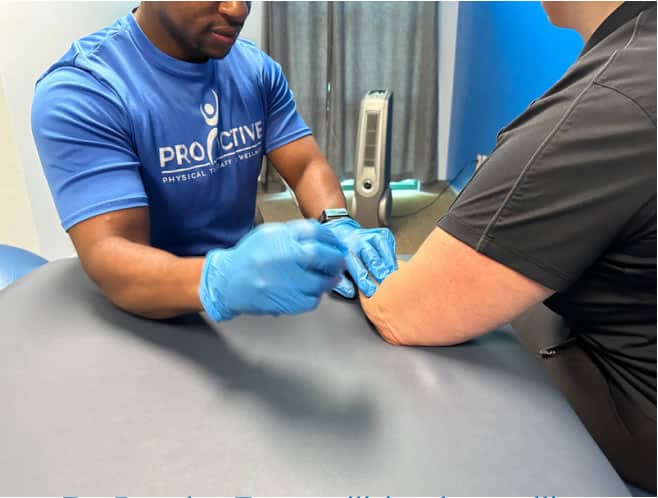
Dry needling is a technique in which a trained physical therapist inserts a thin, sterile, single-use filament needle into or near a muscle trigger point to reduce pain, release muscle tension, and restore range of motion. It's called "dry" needling because nothing is injected: the needle itself is the treatment. Dry needling is also sometimes called functional dry needling, trigger point dry needling, or intramuscular manual therapy, depending on the training program or clinic using the term. They all describe the same core technique.
A trigger point is a tight, tender knot within a muscle that can stay irritated long after the original injury or overuse has healed. Trigger points can be directly painful, and they can also refer pain elsewhere in the body: a trigger point in the upper trapezius, for example, commonly refers pain into the head as a tension-type headache, and trigger points in the hip or glute muscles can mimic sciatica down the leg. Dry needling is typically used alongside, not instead of, manual therapy and exercise as part of a complete physical therapy plan.
Dry Needling vs. Acupuncture: What's the Difference?
Both use thin needles, and that's about where the similarity ends. Acupuncture is rooted in traditional Chinese medicine and is built around the concept of energy flow, or qi, along meridians. Dry needling is a Western medicine technique, grounded in modern neuroanatomy and physiology, performed by a physical therapist to treat a specific muscle trigger point identified through a hands-on evaluation. It's not a philosophy; it's a targeted tool used inside a physical therapy plan.
This is:
- A physical therapy technique performed by a licensed PT
- Based on Western neuroanatomy and trigger point science
- Targeted at the specific muscle identified in your evaluation
- Used alongside manual therapy and exercise as part of your plan
- Supported by a growing body of clinical research
This is not:
- Acupuncture or traditional Chinese medicine
- An injection — nothing is injected into your body
- A stand-alone fix, separate from the rest of your care
- Used on every patient or every condition
How Trigger Points Develop
When a muscle is overused or injured, muscle fibers can tighten into a protective, sustained contraction. That taut band restricts local blood flow, which limits the oxygen and nutrients the muscle needs to recover and allows metabolic waste to build up in the tissue. The muscle responds by releasing chemicals that sensitize nearby nerves, which is what produces the pain, stiffness, and restricted range of motion associated with a trigger point.
Dry needling works by inserting a needle directly into that trigger point, often producing a brief, involuntary muscle twitch. That twitch response is associated with a local reduction in the chemical irritants and a release of the taut band, which is why dry needling can create a change in muscle tension and pain in a way that stretching or massage alone sometimes can't reach.
What to Expect
- A hands-on evaluation first. Your therapist palpates the area to locate the specific trigger point or points involved, rather than needling by guesswork.
- A quick, precise insertion. The needle is inserted through the skin into the muscle, sometimes with gentle movement to elicit a twitch response. Needles stay in anywhere from a few seconds to about 20 minutes, depending on your presentation.
- As few or as many needles as your case calls for. Some sessions use one or two needles; others, particularly along the spine, may use more. Your therapist may add light electrical stimulation to enhance the effect when appropriate.
- Integrated into your broader plan. Dry needling is typically paired with manual therapy and a targeted exercise plan in the same visit, not delivered as an isolated treatment.
Muscle soreness or twitching during and shortly after treatment is normal and expected. Most people notice a change in pain or mobility within the same session; for others, it takes a few sessions to see the full effect.
Built on Evidence, Not Guesswork
Dry needling has a growing body of research behind it. A systematic review and meta-analysis published in the Journal of Orthopaedic and Sports Physical Therapy found dry needling more effective than sham or control treatment for reducing pain and improving pressure pain threshold in the short term across a range of musculoskeletal conditions. A more recent umbrella review, summarizing evidence across multiple body regions, found dry needling superior to sham or no treatment and comparable to other active interventions for short-term pain reduction, with additional improvements in physical function such as range of motion and muscle strength, and a strong overall safety profile when performed by a trained clinician.
Like most manual therapy techniques, the evidence quality varies by condition and the optimal number of sessions differs from person to person, which is why dry needling at ProActive is built into your individualized plan rather than applied as a one-size-fits-all protocol.
What Dry Needling Can Help With
Dry needling is most useful when muscle tension or a trigger point is a meaningful part of the pain picture. As part of a broader physical therapy plan, it's often used for:
- Myofascial and muscular pain, including chronic, hard-to-release knots
- Tension-type headaches referred from trigger points in the neck and upper trapezius
- Neck pain and stiffness
- Shoulder pain, including rotator cuff and upper back tension
- Low back pain and muscle-related tightness along the spine
- Muscle-related contributors to sciatica-like leg pain, such as piriformis or hip muscle involvement
- Tendinopathies, such as tennis elbow or Achilles tendon pain
- Muscle tightness that limits mobility after an old injury
For chronic myofascial or soft-tissue tension that doesn't fully resolve with needling and exercise alone, some patients pair dry needling with shockwave therapy (ESWT) for a more complete approach to stubborn soft-tissue pain.
Safety and Who Should Use Caution
Dry needling is safe when performed by a trained, licensed physical therapist, but it isn't right for every situation. Your therapist will screen for factors that call for extra caution or a different approach first, including pregnancy, active bleeding disorders or blood-thinning medication, needle aversion, active infection or illness, a pacemaker or other implanted device, and unstable fractures. Mild soreness, minor bruising, or brief fatigue after treatment are normal and typically resolve within a day or two. Tell your therapist about your full medical history before your first session so they can determine whether dry needling is appropriate for you.
Why ProActive
- Dry needling is built into your evaluation-based plan, never a stand-alone add-on
- Kentucky is a direct-access state, so you can start without waiting on a referral
- Delivered by our licensed physical therapy team, with a clinical approach designed by Dr. Brandon Evans, PT, DPT, grounded in evaluation, not generic protocols
Visit Our Louisville Clinic
Serving Lyndon, St. Matthews, Hurstbourne, and the greater Louisville, KY area.
Frequently Asked Questions
What is dry needling?
Dry needling is a physical therapy technique where a trained therapist inserts a thin, sterile filament needle into a muscle trigger point to reduce pain, release tension, and improve range of motion. It's sometimes called functional dry needling, trigger point dry needling, or intramuscular manual therapy. Nothing is injected, which is why it's called "dry."
Is dry needling the same as acupuncture?
No. Acupuncture is based on traditional Chinese medicine and the concept of energy flow along meridians. Dry needling is a Western medicine technique grounded in neuroanatomy, performed by a physical therapist to treat a specific muscle trigger point found during a hands-on evaluation. See the full comparison above.
Does dry needling hurt?
The needle itself is thin enough that insertion is usually not painful. You may feel a brief muscle twitch or cramp-like sensation when the needle reaches the trigger point, which is a normal sign the muscle is responding to treatment. Some soreness for a day or two afterward is common, similar to soreness after a hard workout.
What conditions can dry needling help with?
Dry needling is most useful for muscle tension and trigger points contributing to neck pain, shoulder pain, back pain, tension-type headaches, tendinopathies, and muscle-related leg pain that mimics sciatica. It's used as part of a broader physical therapy plan, not as a stand-alone treatment.
How many dry needling sessions will I need?
It depends on how long you've had the issue and how your body responds. Some people notice a change in pain or mobility after the first session; others need a few sessions before the effect holds. Your therapist builds this into your overall plan rather than prescribing a fixed number up front.
Is dry needling safe?
Yes, when performed by a trained, licensed physical therapist using sterile, single-use needles. It's not appropriate for everyone: pregnancy, active bleeding disorders or blood thinners, needle aversion, active infection, a pacemaker, or an unstable fracture are all reasons your therapist may recommend a different approach. See the safety section above.
Is dry needling covered by insurance or Medicare?
Dry needling is provided as part of your physical therapy treatment plan at ProActive. How that's handled for your specific situation, including Medicare, is easiest to walk through on a call. Call or text us at (502) 512-2165 and we'll answer your specific questions.
Do I need a doctor's referral for dry needling?
No. Kentucky is a direct-access state, which means you can start physical therapy, including dry needling, at ProActive Physical Therapy and Wellness without a physician's referral. Medicare and some insurance plans have their own separate requirements, so call or text us and we'll walk you through what applies to your specific situation.
How do I get started?
Call or text us at (502) 512-2165, or email info@proactiveptlou.com. We'll talk through your history and figure out together whether dry needling is a good fit as part of your plan.
Talk to us first — complimentary, no pressure, no obligation.
Prefer to text or email instead? Same number: (502) 512-2165.
Sources
Gattie E, Cleland JA, Snodgrass S. The Effectiveness of Trigger Point Dry Needling for Musculoskeletal Conditions by Physical Therapists: A Systematic Review and Meta-analysis. J Orthop Sports Phys Ther. 2017;47(3):133–149.
Chys M, De Meulemeester K, De Greef I, Murillo C, Kindt W, Kouzouz Y, Lescroart B, Cagnie B. Clinical Effectiveness of Dry Needling in Patients with Musculoskeletal Pain — An Umbrella Review. J Clin Med. 2023;12(3):1205.
