If you’ve been told you have osteopenia or osteoporosis, you’ve probably also been told to “be careful” — avoid falls, avoid high-impact activity, maybe just walk more. That advice isn’t wrong, but it’s incomplete. Bone is living tissue, and like muscle, it adapts to the forces placed on it. A leisurely walk and a light resistance band keep you moving, but they don’t apply enough load to change bone density. The exercise that does is targeted, progressive strength training.
At ProActive Physical Therapy and Wellness, our Osteogenic Strength Program in Louisville, KY is built around this exact evidence: heavy, progressive resistance and impact training, dosed individually and delivered under direct supervision, is the closest thing bone health has to a gold standard.
Serving Louisville, Lyndon, St. Matthews, Middletown, and surrounding Jefferson County communities.
Watch how the Osteogenic Strength Program works — real supervised loading, not a generic exercise class.
Quick summary: For adults with osteopenia or osteoporosis, functional strength training — progressive resistance and impact exercise dosed heavily enough to load bone — is considered the gold-standard exercise approach for building or preserving bone mineral density. The 2018 LIFTMOR randomized controlled trial found that eight months of twice-weekly, supervised high-intensity resistance and impact training increased lumbar spine bone density by 2.9% (versus a 1.2% loss in the control group), with no fractures and only one minor muscle strain across more than 2,600 training sessions. Walking, light resistance bands, and general fitness classes support overall health but do not apply enough mechanical load to meaningfully change bone density.
What Is Osteopenia? What Is Osteoporosis?
Osteopenia and osteoporosis are both measures of bone mineral density (BMD), typically diagnosed with a DXA (dual-energy X-ray absorptiometry) scan and reported as a T-score — how your bone density compares to that of a healthy young adult.
- Normal bone density: T-score of -1.0 or above
- Osteopenia (low bone mass): T-score between -1.0 and -2.5
- Osteoporosis: T-score of -2.5 or below
In plain English: osteopenia means your bones are thinner than average for a young adult but haven’t crossed the threshold where fracture risk is classified as high. Osteoporosis means that threshold has been crossed — bone has become porous enough that everyday forces (a fall, a hard sneeze, lifting a bag of mulch the wrong way) can cause a fracture that wouldn’t occur in denser bone. A person can also be diagnosed with osteoporosis at a higher T-score if they’ve already had a fragility fracture or if a formal risk assessment (FRAX) shows their 10-year fracture risk is high.
Osteopenia and osteoporosis are common. An analysis of national health data estimated that 54 million U.S. adults age 50 and older have osteoporosis or low bone mass — about 10.2 million with osteoporosis and 43.4 million with osteopenia. [2] Most cases are asymptomatic until a fracture occurs, which is why bone density is often called a “silent” condition — and why waiting for symptoms before addressing it isn’t a strategy.
Why Functional Strength Training Is Considered the Gold Standard
The mechanism: bone responds to load, not motion
Bone remodels constantly. Specialized cells called osteoclasts break down old bone while osteoblasts build new bone. The balance between the two shifts with age, hormones (especially estrogen decline after menopause), and — critically — mechanical loading. When bone experiences strain above a certain threshold, it signals osteoblasts to lay down new bone in response. This is sometimes called Wolff’s Law or mechanotransduction: bone adapts its structure to the demands placed on it.
The problem is that the threshold needed to trigger this response tends to be higher than most people’s daily activity — and higher than most standard exercise recommendations. Walking, swimming, cycling, and light resistance bands are valuable for cardiovascular health, joint mobility, and general muscle endurance, but for someone who is already active, they typically don’t apply enough mechanical load to meaningfully change bone density. Heavy, progressive resistance training and controlled impact loading do.
What the research shows: the LIFTMOR trial
The clearest evidence for this comes from the LIFTMOR randomized controlled trial (Watson et al., published in the Journal of Bone and Mineral Research, 2018). [1] Researchers assigned postmenopausal women with low bone mass to either eight months of twice-weekly, fully supervised high-intensity resistance and impact training (HiRIT) — deadlifts, overhead presses, and back squats performed at 80–85% of one-rep max, plus jumping chin-ups and drop landings for impact — or a low-intensity home exercise program.
| Outcome (8 months) | High-Intensity Resistance & Impact Training | Low-Intensity Control Group |
|---|---|---|
| Lumbar spine bone density | +2.9% | -1.2% |
| Femoral neck (hip) bone density | +0.3% | -1.9% |
| Back extensor strength | +36.0% | +11.0% |
| Height (posture) | +0.2 cm | -0.2 cm |
Just as important as the results is the safety record: across more than 2,600 supervised training sessions, researchers recorded a single adverse event — a minor low-back strain that caused two missed sessions — and no fractures in either group. [1] A related trial (LIFTMOR-M) extended a similar protocol to middle-aged and older men with low bone mass, with encouraging results for bone geometry and strength as well. [3] This isn’t a women-only strategy — men lose bone density too, just later on average.
The takeaway isn’t “lifting heavy is dangerous, so be gentle.” It’s the opposite: appropriately dosed heavy loading, done under supervision with proper screening and technique, was safe and effective — while under-dosed exercise still resulted in bone loss.
Wondering if your current exercise routine is actually loading your bones?
A readiness assessment identifies your starting point and whether a progressive, supervised program is appropriate for your bone density and health history.
Speak to a Specialist
Call (502) 512-2165
See the Osteogenic Strength Program
“Functional” Strength Training vs. a Regular Gym Routine
Not all strength training is built the same, and this is where a lot of well-meaning advice falls short. A fitness class with light dumbbells, a machine-only circuit, or an unsupervised bodyweight routine can be a fine starting point for general health — but it usually isn’t dosed heavily enough, or progressed deliberately enough, to change bone density.
Functional strength training for bone health means:
- Compound, multi-joint movements that mirror real-world tasks — squatting, hinging, pressing, carrying — rather than isolated single-muscle exercises
- Progressive overload — the load increases deliberately over weeks and months as tolerance and technique improve, rather than staying at the same light weight indefinitely
- Individualized dosing based on your T-score, fracture history, and readiness — what’s appropriate for someone with osteopenia and no fracture history is not automatically appropriate for someone with an existing vertebral compression fracture
- Impact loading where appropriate — controlled jumps, drop landings, or heel drops, which apply a different and additional bone-loading stimulus than resistance training alone
A common misconception is that lifting heavy is inherently risky for someone with low bone density, so “light weights, high reps” is the safer default. The LIFTMOR data suggests the opposite problem is more common: under-dosed exercise that feels safe but doesn’t provide enough stimulus to change bone. The real safety variable isn’t the weight on the bar — it’s whether the program is properly assessed, taught, and progressed.
Exercises That Support Bone Density
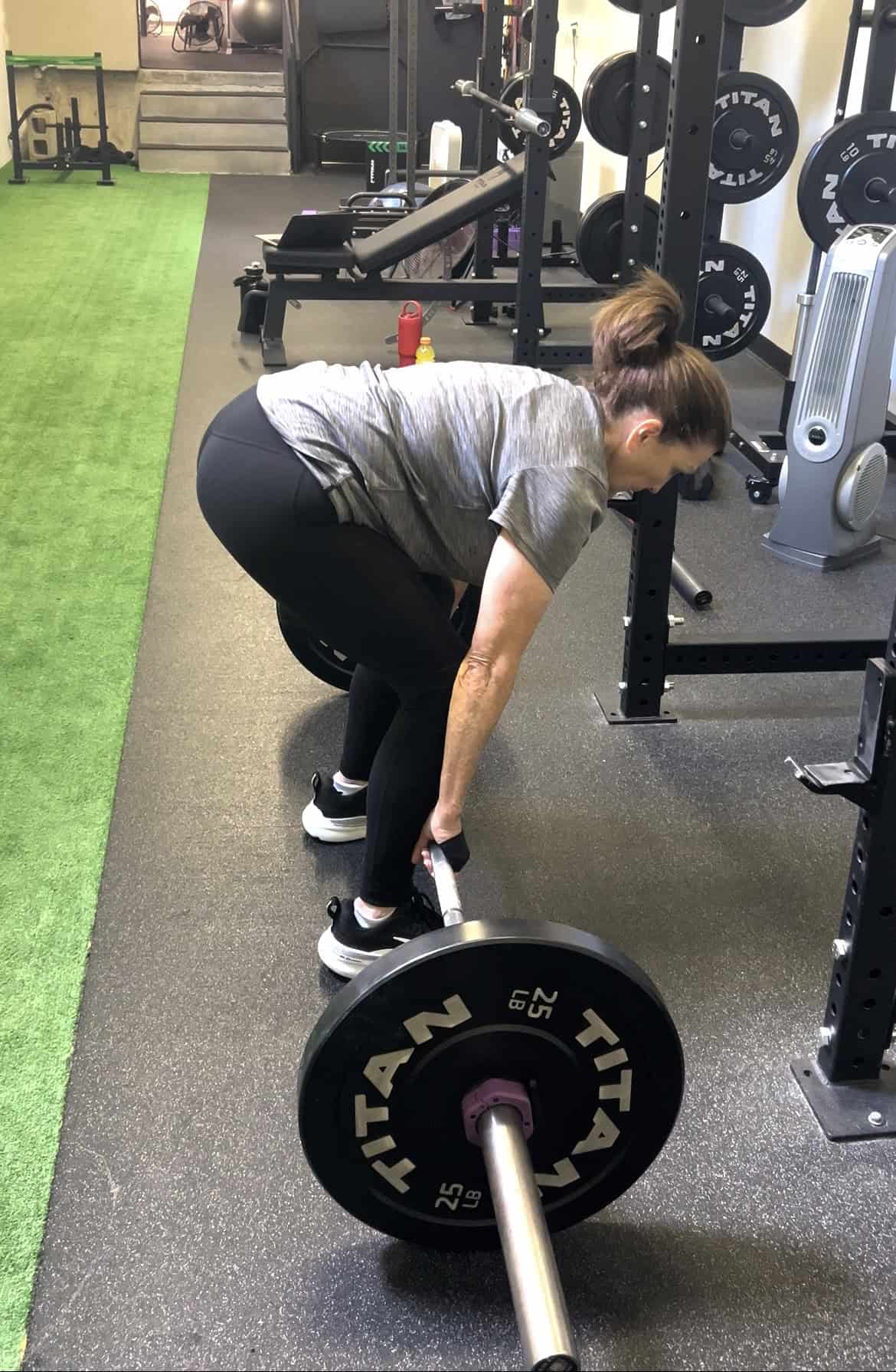
Coached conventional deadlift as part of the Osteogenic Strength Program — progressive loading builds bone density over time.
Depending on your bone density, fracture history, and current strength, an individualized program may include progressions of:
- Squats — loads the hips, spine, and legs through a functional movement pattern
- Deadlifts (trap bar or conventional) — loads the hips and lower back heavily; the trap bar variation is often used first for a more spine-friendly setup
- Step-ups — builds single-leg strength and balance while loading the hip and spine
- Overhead presses — loads the shoulders and upper spine, which supports posture
- Rows — strengthens the upper back muscles that counteract a forward-stooped posture
- Loaded carries — builds grip, core, and postural strength under load
- Controlled heel drops or low hops — when appropriate, adds an impact-loading stimulus that resistance training alone doesn’t provide
The exercises themselves aren’t exotic. What matters is the dosing, the progression, and the supervision — which is exactly what separates a program built for bone health from a generic workout.
What to Avoid With Osteoporosis or Osteopenia
Some movement patterns increase the risk of a spinal compression fracture in someone with low bone density, and it’s reasonable to modify or avoid them, especially with a confirmed osteoporosis diagnosis or an existing vertebral fracture:
- Spinal flexion under load or momentum — sit-ups, crunches, toe touches, and rounding the back while lifting
- Twisting at the waist with load — some golf swings, certain yoga twists, and rotational exercises done carelessly
- Uncontrolled high-impact activity — running or jumping without an assessment of your bone density and joint tolerance first
These recommendations come from established clinical guidance, including Mayo Clinic’s patient education on exercising safely with osteoporosis. [4] That said, “avoid” doesn’t mean “avoid all exercise.” The far more common mistake we see is the opposite one: someone who becomes so cautious after a diagnosis that they stop challenging their muscles and bones altogether. Deconditioning from inactivity compounds bone loss and muscle weakness, and it increases fall risk — the very thing many people are trying to avoid. The goal isn’t to do less. It’s to do the right things, dosed correctly.
Strength Training Builds Bone. It Doesn’t Automatically Prevent Falls.
This distinction gets lost often enough that it’s worth stating plainly: building bone density reduces the odds that a given fall or impact results in a fracture. It does not, by itself, reduce your odds of falling in the first place. Falls are driven by a separate set of factors — balance, reaction time, vision, footwear, home hazards, and lower-body strength for quick corrective steps.
Most fragility fractures happen because of a fall, not because bone spontaneously breaks. [5] That means a complete strategy addresses both sides: bone density through progressive loading, and fall risk through balance training. If you’ve had a fall in the past year, feel unsteady on uneven ground, or have a vestibular or inner-ear issue affecting balance, that’s a separate but complementary piece of the picture — often addressed through dedicated Balance & Fall Prevention physical therapy alongside a strength program.
Why an Assessment Comes Before the Weights
Two people with the same T-score can need very different starting points. Someone with osteopenia and no fracture history can typically progress toward heavier loading faster than someone with osteoporosis and an existing vertebral compression fracture, who may need more conservative loading, more spinal-position coaching, and closer monitoring early on. Medication history, cardiovascular status, other joint conditions, and prior injury all factor in too.
This is why a program built around bone health should start with a readiness assessment — reviewing your bone density results, fracture and fall history, current strength, and movement patterns — before any heavy loading begins. It’s also the main difference between a program designed specifically around the LIFTMOR evidence and a general strength class: the dosing is set for you, not for the group.
How the ProActive Osteogenic Strength Program Works

Dr. Brandon Evans, PT, DPT
Owner & Physical Therapist, ProActive Physical Therapy and Wellness — designer of the Osteogenic Strength Program
Dr. Brandon Evans, PT, DPT, designed the Osteogenic Strength Program at ProActive Physical Therapy and Wellness in Louisville, KY specifically around this evidence base. A few things worth knowing:
- It’s a clinician-led wellness program using progressive resistance and impact training — not a fitness class, and not a replacement for medical treatment of osteoporosis.
- It’s not billed as physical therapy or through insurance. It’s a structured, one-on-one wellness program.
- It starts with a DPT-led readiness assessment before any lifting begins.
- Phase 1 is a 4-month foundation, twice weekly, one-on-one, using progressions of squats, deadlifts (trap bar or conventional), step-ups, overhead presses, rows, loaded carries, and — when appropriate — controlled heel drops or low hops.
- Phase 2 continues progression long-term as strength and confidence build.
Full program details, including how it complements Balance & Fall Prevention physical therapy when needed, are on our Osteogenic Strength Program page.
People Also Ask
Can strength training reverse osteoporosis?
Strength training can meaningfully improve bone density and may move some people from osteoporosis-range T-scores toward osteopenia-range over time, but “reversal” isn’t guaranteed or promised for everyone. The LIFTMOR trial showed measurable bone density gains over 8 months of supervised high-intensity training; individual results depend on starting bone density, age, hormonal factors, consistency, and any underlying medical conditions. It’s most accurate to say strength training can improve bone density and reduce fracture risk factors for many people — how much varies by individual.
Is it safe to lift heavy weights with osteoporosis?
For most people, yes — when the program is properly assessed, dosed, and supervised. In the LIFTMOR trial, high-intensity resistance and impact training produced only one minor muscle strain and no fractures across more than 2,600 sessions in women with low bone mass. The key variables are proper screening, technique, and progression, not simply avoiding heavy loads. Anyone with a recent fracture, significant cardiovascular concerns, or other complicating factors should be individually assessed before starting.
What’s the difference between osteopenia and osteoporosis?
Both are measured by T-score on a DXA scan. Osteopenia is a T-score between -1.0 and -2.5 (lower-than-average bone density). Osteoporosis is a T-score of -2.5 or below, or a diagnosis based on a prior fragility fracture. Osteoporosis carries a higher fracture risk than osteopenia.
Can walking alone improve bone density?
Walking supports cardiovascular health, joint mobility, and general well-being, and some weight-bearing benefit exists, but for most people who are already ambulatory, walking alone doesn’t apply enough mechanical load to meaningfully increase bone density. Progressive resistance training and impact loading are needed to create that stimulus.
How often should I strength train for bone health?
The LIFTMOR protocol used twice-weekly supervised sessions over 8 months. Frequency and intensity should be individualized based on your bone density, fracture history, and how your body responds — which is why programs typically start with a readiness assessment rather than a fixed prescription.
Does strength training prevent falls too?
Strength training, particularly lower-body strength, contributes to fall prevention by improving your ability to catch yourself and react quickly. But building bone density and preventing falls are two different goals. A complete approach often pairs strength training with dedicated balance training, especially for anyone with a recent fall or balance concern.
What exercises should I avoid with osteoporosis?
Common movements to modify or avoid include spinal flexion under load (sit-ups, crunches, toe touches), twisting the spine under load, and uncontrolled high-impact activity without prior assessment. This doesn’t mean avoiding exercise altogether — inactivity carries its own risks for bone and muscle health.
Ready to find out what your bones actually need?
Speak to a specialist at ProActive Physical Therapy and Wellness in Louisville, KY. We’ll review your bone density results and health history and build a progressive strength plan around them.
References
- Watson SL, Weeks BK, Weis LJ, Harding AT, Horan SA, Beck BR. High-Intensity Resistance and Impact Training Improves Bone Mineral Density and Physical Function in Postmenopausal Women With Osteopenia and Osteoporosis: The LIFTMOR Randomized Controlled Trial. Journal of Bone and Mineral Research. 2018.
(PubMed)
▲ - Bone Health & Osteoporosis Foundation (formerly National Osteoporosis Foundation), citing Wright NC, et al. The Recent Prevalence of Osteoporosis and Low Bone Mass in the United States Based on Bone Mineral Density at the Femoral Neck or Lumbar Spine. Journal of Bone and Mineral Research. 2014.
(BHOF)
▲ - Harding AT, Weeks BK, Lambert C, Watson SL, Weis LJ, Beck BR. A Comparison of Bone-Targeted Exercise Strategies to Reduce Fracture Risk in Middle-Aged and Older Men With Osteopenia and Osteoporosis: LIFTMOR-M. Journal of Bone and Mineral Research. 2020.
(ScienceDirect)
▲ - Mayo Clinic. Exercising with osteoporosis: Stay active the safe way.
(Mayo Clinic)
▲ - International Osteoporosis Foundation. Exercise for individuals with osteoporosis.
(IOF)
▲

Brandon Evans
Latest posts by Brandon Evans (see all)
- Functional Strength Training for Osteoporosis and Osteopenia: Why It’s the Gold Standard - August 21, 2026
- Shockwave Therapy in Louisville, KY: Benefits of ESWT for Chronic Tendon Pain (Adults 40+) - February 25, 2026
- The Truth About “Bone-on-Bone” Knees: What MRIs Don’t Tell You About Pain - October 27, 2025
